

You’re building an app, you need it to talk to a server, and suddenly everyone’s throwing acronyms at you: REST, GraphQL, SOAP. They all move data between systems — so why are there three of them, and which one should you actually use?
Here’s the thing most explainers get wrong: they bury you in jargon before you understand what these tools even are. In plain English, all three are ways for one program to ask another program for data or actions — they just do it with very different styles, trade-offs, and philosophies.
By the end of this guide you’ll understand exactly what each one is, how they differ (with real code examples), a clear head-to-head comparison, and a simple rule for picking the right one. Whether you’re a beginner or a dev tired of hand-wavy answers, let’s make this click.
📌 Key Takeaways
- SOAP is a strict, XML-based protocol — heavy, secure, and still common in enterprise/legacy systems.
- REST is a flexible architectural style using standard HTTP and JSON — the default for most modern APIs.
- GraphQL is a query language that lets the client ask for exactly the data it needs from one endpoint.
- Rule of thumb: REST by default, GraphQL for complex/nested data, SOAP for strict enterprise contracts.
- They can — and often do — coexist in the same system.
⚡ The Short Answer
Think of it as a spectrum of control and complexity. SOAP is the rigid, formal contract — verbose but bulletproof. REST is the easygoing standard — simple, scalable, and everywhere. GraphQL is the precision tool — the client asks for exactly what it wants, nothing more. For most new projects, start with REST and only reach for the others when you have a specific reason.
First, What Is an API?
Before comparing the three, one quick foundation. An API (Application Programming Interface) is simply a contract that lets two pieces of software talk to each other. Your weather app doesn’t own the forecast — it asks a weather service’s API for it and gets data back.
REST, GraphQL, and SOAP are three different styles for designing that conversation — how the request is shaped, what format the data comes back in, and how strict the rules are. Same goal, different rulebooks.
What Is SOAP? (The Strict Elder)
SOAP (Simple Object Access Protocol) is a formal, XML-based messaging protocol with strict rules and built-in standards for security and reliability. Born in the late 1990s, it was the enterprise standard long before REST existed.
Every SOAP message is a structured XML “envelope” that follows a rigid contract (often described in a WSDL file). That verbosity is the point: SOAP bakes in enterprise-grade features like WS-Security and formal transaction handling, which is why banks, payment processors, and telecoms still rely on it. The trade-off is weight — it’s heavier, slower, and harder to work with than the alternatives.
What Is REST? (The Modern Standard)
REST (Representational State Transfer) is an architectural style that models everything as “resources” you access over standard HTTP, usually exchanging lightweight JSON. If you’ve used almost any modern web or mobile API, you’ve used REST.
The idea is elegantly simple: each thing (a user, a product, an order) is a resource at a URL, and you act on it with standard HTTP verbs — GET to read, POST to create, PUT to update, DELETE to remove. It’s easy to learn, plays perfectly with web caching, and scales beautifully. Its main weakness: you often get back more data than you need (over-fetching) or have to make several calls to assemble one screen (under-fetching).
What Is GraphQL? (The Precision Tool)
GraphQL is a query language for APIs that lets the client request exactly the data it wants — no more, no less — from a single endpoint. Developed by Facebook and open-sourced in 2015, it was built to solve REST’s over- and under-fetching headaches.
Instead of many URLs, GraphQL exposes one endpoint. The client sends a query describing the exact shape of the data it needs, and the server returns precisely that — even stitching together data from multiple sources in a single round trip. It’s brilliant for complex, nested data and apps with many different clients. The cost: it’s more complex to set up, and HTTP caching gets trickier.
The Core Difference (Same Request, Three Styles)
Nothing makes this clearer than watching all three fetch the same thing — a user’s name and email:
# REST — hit a resource URL, get the whole object back
GET /api/users/42
// Response: { id, name, email, address, phone, createdAt, ... }

# GraphQL — one endpoint, ask for exactly the fields you want
POST /graphql
{ user(id: 42) { name email } }
// Response: { "user": { "name": "...", "email": "..." } }

# SOAP — verbose XML envelope, operation-based
POST /UserService
<soap:Envelope><soap:Body>
  <getUser><id>42</id></getUser>
</soap:Body></soap:Envelope>
// Response: a full XML document
See it? REST hands you the whole user. GraphQL hands you only the two fields you asked for. SOAP wraps everything in a strict XML envelope. That single example captures the entire philosophy of each.
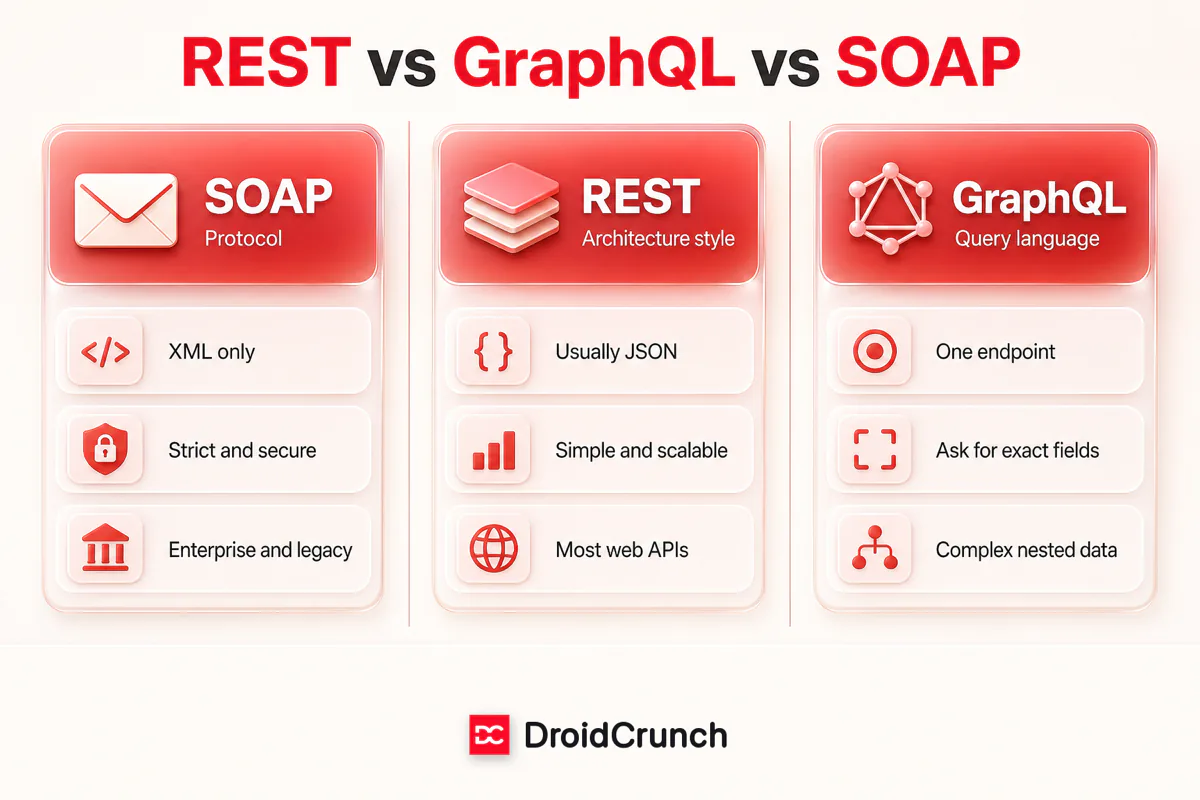
REST vs GraphQL vs SOAP: Head-to-Head
| Factor | SOAP | REST | GraphQL |
|---|---|---|---|
| Type | Protocol | Architectural style | Query language |
| Data format | XML only | Usually JSON | JSON |
| Endpoints | Single, operation-based | Multiple, resource-based | Single endpoint |
| Flexibility | Rigid contract | Flexible | Very flexible |
| Over/under-fetching | N/A | Common | Solved |
| Learning curve | Steep | Easy | Moderate |
| Caching | Hard | Easy (HTTP) | Harder |
| Built-in security | Strong (WS-Security) | Via HTTPS/OAuth | Via HTTPS/OAuth |
| Age | 1998 (mature) | 2000 (dominant) | 2015 (growing) |
| Best for | Enterprise, banking, legacy | Most web & mobile APIs | Complex, nested data |
REST vs GraphQL: The Modern Debate
This is the comparison that matters most today, because it’s the real choice for most new projects. It comes down to over-fetching and under-fetching.
With REST, an endpoint returns a fixed shape. Want just a user’s name? You still get the whole object (over-fetching). Want a user and their last three orders? That might be three separate calls (under-fetching). GraphQL fixes both: one query, exactly the fields you want, from one request. But REST answers back with simplicity and caching — a plain GET is trivially cached by browsers and CDNs, while GraphQL’s single POST endpoint makes that harder.
Our take: GraphQL isn’t “better” than REST — it’s better at a specific problem. If you’re not fighting over-fetching or juggling many clients, REST’s simplicity usually wins. Don’t adopt GraphQL for the resume line.
REST vs SOAP: Old Guard vs New Standard
This one’s more clear-cut. REST replaced SOAP as the default for public and mobile APIs because it’s lighter, faster, and far easier to work with — JSON over plain HTTP versus verbose XML envelopes. For most modern apps, REST wins on developer experience alone.
SOAP still holds its ground where its strictness is a feature, not a bug: formal contracts, built-in security, and guaranteed reliability. In banking, payments, healthcare, and legacy enterprise integrations, those guarantees are worth the extra weight. New public API? REST. Bank-to-bank transaction system? SOAP still earns its keep.
Strengths and Weaknesses of Each
📡 REST — best for: the vast majority of web and mobile APIs, public APIs, and anything that benefits from simple caching. Watch out: over-fetching, under-fetching, and version sprawl on complex data.
🔋 GraphQL — best for: complex, deeply nested data, apps with many different clients (web, iOS, Android), and killing over-fetching. Watch out: setup complexity, trickier caching, and easy-to-write expensive queries.
💼 SOAP — best for: enterprise systems needing strict contracts, formal security, and guaranteed reliability — banking, payments, telecom, healthcare. Watch out: verbosity, a steep learning curve, and poor fit for lightweight web/mobile apps.
When to Use Which
- Building a standard web or mobile API? → REST. It’s the safe, simple, well-understood default.
- Complex, nested data or many client apps? → GraphQL. Let each client fetch exactly what it needs.
- Enterprise, finance, or a strict legacy system? → SOAP. Its guarantees are worth the weight.
- Not sure? → Start with REST. You can always add GraphQL later where it earns its place.
Can They Work Together?
Absolutely — and in big systems they usually do. It’s common to see SOAP powering legacy internal services, REST exposing the public API, and a GraphQL layer sitting on top to stitch multiple sources into exactly what the front-end needs. These aren’t rival religions; they’re tools you mix per job.
You’ll also meet all three when wiring up automations. Tools like n8n connect to APIs of every style, and our Zapier vs n8n comparison shows how much of modern software is really just APIs talking to APIs. For more explainers, browse our API guides.
Common Misconceptions
- “GraphQL replaces REST.” No — it’s an alternative for specific needs. REST still powers most of the web.
- “SOAP is dead.” Far from it in enterprise and finance, where its guarantees still matter.
- “REST and GraphQL are the same kind of thing.” They’re not — REST is an architectural style, GraphQL is a query language.
- “GraphQL is always faster.” Only sometimes. Poorly written queries can be slow, and REST’s caching often wins.
Frequently Asked Questions
What is the difference between REST, GraphQL, and SOAP?
SOAP is a strict XML-based protocol, REST is a flexible architectural style that usually returns JSON over standard HTTP, and GraphQL is a query language that lets the client ask for exactly the data it needs from a single endpoint. They solve the same problem in very different ways.
Is GraphQL better than REST?
Not universally. GraphQL is better when clients need flexible, nested data and you want to avoid over-fetching, while REST is simpler, easier to cache, and perfect for most standard APIs. Many teams use REST by default and add GraphQL only where its flexibility pays off.
Is SOAP still used today?
Yes, but mostly in legacy and enterprise systems like banking, payments, and telecom, where its strict contracts, built-in security, and reliability standards matter. For new public and mobile APIs, most developers choose REST or GraphQL instead.
Which is fastest, REST, GraphQL, or SOAP?
It depends on the use case. REST is fast and easily cached, GraphQL can be faster over slow networks because it fetches exactly what is needed in one request, and SOAP is usually the heaviest due to its verbose XML. Real-world speed depends more on your design than the style.
Should I use REST or GraphQL for a new project?
Start with REST unless you have a clear reason not to. It is simpler, well understood, and easy to cache. Choose GraphQL when you have complex, deeply nested data, many different clients, or you keep fighting over-fetching and under-fetching with REST.
Do REST, GraphQL, and SOAP use HTTP?
REST and GraphQL are built on HTTP, with GraphQL typically using a single POST endpoint. SOAP usually runs over HTTP too, but it can also use other transports like SMTP, since SOAP is a transport-independent messaging protocol.
Can REST, GraphQL, and SOAP be used together?
Yes. Large systems often mix them: SOAP for legacy internal services, REST for public APIs, and GraphQL as a flexible layer that stitches multiple sources together for front-end apps. The right tool depends on each specific job.
What data format does each API use?
SOAP uses XML exclusively. REST commonly uses JSON but can return XML, HTML, or other formats. GraphQL returns JSON. JSON is lighter and easier to read than XML, which is a big reason REST and GraphQL overtook SOAP for modern web and mobile apps.
The Bottom Line
REST, GraphQL, and SOAP aren’t competitors fighting for one crown — they’re three tools tuned for different jobs. REST is the simple, scalable default that powers most of the modern web. GraphQL is the precision instrument for complex data and demanding front-ends. SOAP is the heavyweight that still guards the enterprise where strict contracts and security rule.
So don’t ask “which is best?” Ask “what does this project need?” For most people, the answer is start with REST, reach for GraphQL when its flexibility clearly pays off, and use SOAP when an enterprise system demands it. Understand the trade-offs and the choice makes itself.