

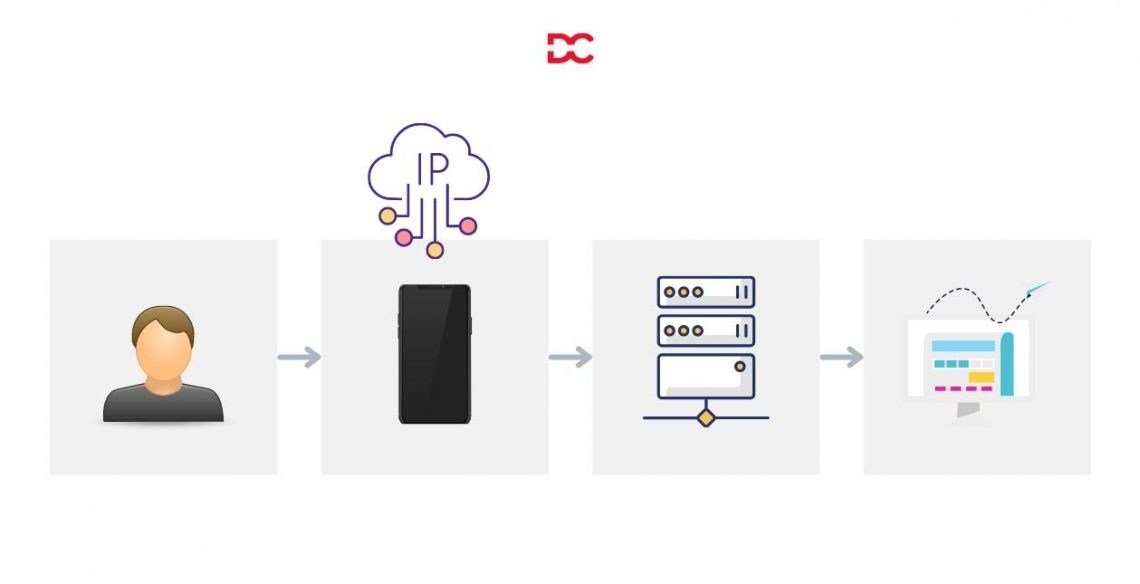
You found the data you need, set up the tool, hit run — and forty requests later everything is a CAPTCHA wall. Or you logged into a client’s social account from your IP one time too many, and now it’s flagged. If you’ve ever been blocked, banned, or rate-limited doing perfectly legitimate work online, you already know why residential proxies exist.
A residential proxy routes your traffic through a real home IP address assigned by an actual ISP — so to the target website, you look like a normal person browsing from a real house, not a bot in a datacenter. That single difference is what keeps scrapers running, ad verification honest, and multi-account work alive.
Here’s the catch: the residential proxy market is crowded, pricing models are confusing (per GB? per port? per month?), and a bad provider burns your budget on blocked IPs. We’ve used and tracked these networks for years across our own scraping and SEO projects — below are the providers we’d actually spend money on, what each is best at, and how to pick the right one without overpaying.
Quick verdict: Oxylabs is our top overall pick — a 100M+ IP pool, ~99.5% success rate, and free city-level targeting. Decodo (formerly Smartproxy) is the best value for most people, and IPRoyal is the budget pick thanks to traffic that never expires.
What is a residential proxy (and why sites trust it)?
When you connect through a residential proxy, your request travels through an IP address that belongs to a real household internet connection. The target website sees that home IP — with a legitimate ISP name and a believable location attached — instead of yours. In plain English: you borrow someone’s digital street address, with their network’s reputation included.

This matters because most large websites now run anti-bot systems that score every visitor’s IP. Datacenter IPs — the kind cloud servers use — are cheap, fast, and instantly recognizable, so they get flagged first. Residential IPs blend in with normal traffic, which is why they survive where datacenter proxies get blocked. (For a deeper comparison of the middle-ground option, see our guide to ISP proxies vs residential proxies.)

Typical jobs where residential proxies earn their keep: web scraping and price monitoring, ad verification, SEO rank tracking, managing multiple social or marketplace accounts, sneaker/ticket purchasing, and accessing geo-restricted content for testing. If your task involves not being detected as automation, this is the proxy type you want.
Best residential proxy providers compared
Before the deep dives, here’s the whole market on one screen. Starting prices are pay-as-you-go rates checked in July 2026 — proxy pricing changes constantly, so verify on the official page before buying.
| Provider | IP pool | Starts at | Best for |
|---|---|---|---|
| Oxylabs | 100M+ | $4/GB | Enterprise scraping at scale |
| Bright Data | 72M+ | ~$5/GB | Advanced targeting & tooling |
| IPRoyal | 32M+ | $1.75/GB | Budget buyers (traffic never expires) |
| ProxyEmpire | 9M+ | ~$1.97/GB | Granular geo-targeting on a budget |
| Nimbleway | Premium pool | Usage-based plans | AI-driven data pipelines |
| Decodo (ex-Smartproxy) | 115M+ | ~$2/GB | Best value for most users |
| NetNut | 85M+ | Volume plans | Speed via direct ISP connectivity |
| StormProxies | Smaller pool | Port-based monthly | Simple unlimited-bandwidth ports |
| Shifter | Large P2P pool | ~$0.75/GB | Cheap rotating proxies at volume |
Who should pick what
- Serious scraping business / large scale: Oxylabs or Bright Data — the pools, success rates, and support are worth the premium.
- Freelancer or small team: Decodo — near-enterprise quality at roughly half the price.
- Occasional, low-volume use: IPRoyal — buy a few GB once; it never expires, so nothing goes to waste.
- Country/city/ASN-specific projects: ProxyEmpire or Bright Data — the deepest geo-targeting options.
- Heavy bandwidth, fixed budget: StormProxies or Shifter — port-based/cheap-GB models beat per-GB billing when you burn serious traffic.
List of Best Residential Proxy Providers in 2026
1. Oxylabs — best overall for scale
Our take: if proxies are core to your business, Oxylabs is the safest money you can spend. The 100M+ residential pool is the largest we’ve tested against hard targets, the ~99.5% success rate held up in our scraping runs, and city/state-level targeting costs nothing extra — something most rivals charge for.
The dashboard and docs are genuinely good, so setup takes minutes, and 24/7 support actually answers. Beyond rotating residential, they cover SOCKS5, datacenter, static residential (ISP), and mobile proxies, so you can consolidate everything with one vendor. It’s a close race with Bright Data at the top — we compared them head-to-head in Bright Data vs Oxylabs.
Key Features:
- 100M+ residential IP pool with continuous rotation
- ~99.5% success rate, avg. 0.6s response time
- Country, state, and city targeting at no extra cost
- Unlimited concurrent sessions
- Ethically sourced pool + strong compliance record
Pricing: pay-as-you-go from $4/GB; monthly plans lower the per-GB rate.
Best for: businesses scraping at scale that can’t afford failed requests. Not ideal for: hobby projects — you’d be paying for enterprise headroom you won’t use.
2. Bright Data — most advanced tooling
Our take: Bright Data is the power user’s choice. No other provider matches its targeting depth — country, city, carrier, even ASN-level — or its ecosystem of data-collection tools (Proxy Manager, browser extension, scraping APIs). The learning curve is steeper and billing is easy to overrun if you don’t set limits, but the capability ceiling is unmatched.
Their rotating residential network is among the fastest and most undetectable we’ve run, with unlimited concurrent requests and a 99.99% uptime record. If your project needs surgical geo-precision or you’re building a serious data pipeline, this is where you land.
Key Features:
- 72M+ ethically-sourced residential IPs
- Target any country, city, carrier & ASN
- 99.99% uptime with unlimited concurrency
- Proxy Manager, browser extension & scraping APIs
Pricing: pay-as-you-go from roughly $5/GB (watch for frequent promos).
Best for: advanced users needing precise targeting and tooling. Not ideal for: beginners — the platform can feel overwhelming, and costs need active monitoring.
3. IPRoyal — best budget pick (traffic never expires)
Our take: IPRoyal’s killer feature is boring but brilliant — your purchased traffic never expires. For anyone whose proxy use is bursty (a scrape this month, nothing next month), that alone beats every subscription in this list. At $1.75/GB it’s also one of the cheapest legitimate entries into residential proxies.
The pool is smaller than the giants’, so extremely hard targets may block more often — but for everyday scraping, geo-testing, and account management it performs well above its price. Full details in our IPRoyal review.
Key Features:
- 32M+ ethically sourced IPs across 195 countries
- Non-expiring traffic — buy once, use whenever
- Rotating and sticky sessions, SOCKS5 support
- Country, state, and city-level targeting + API access
Pricing: from $1.75/GB, cheaper in bulk.
Best for: budget buyers and occasional users. Not ideal for: massive-scale scraping against heavily protected sites.
4. ProxyEmpire — granular geo-targeting on a budget
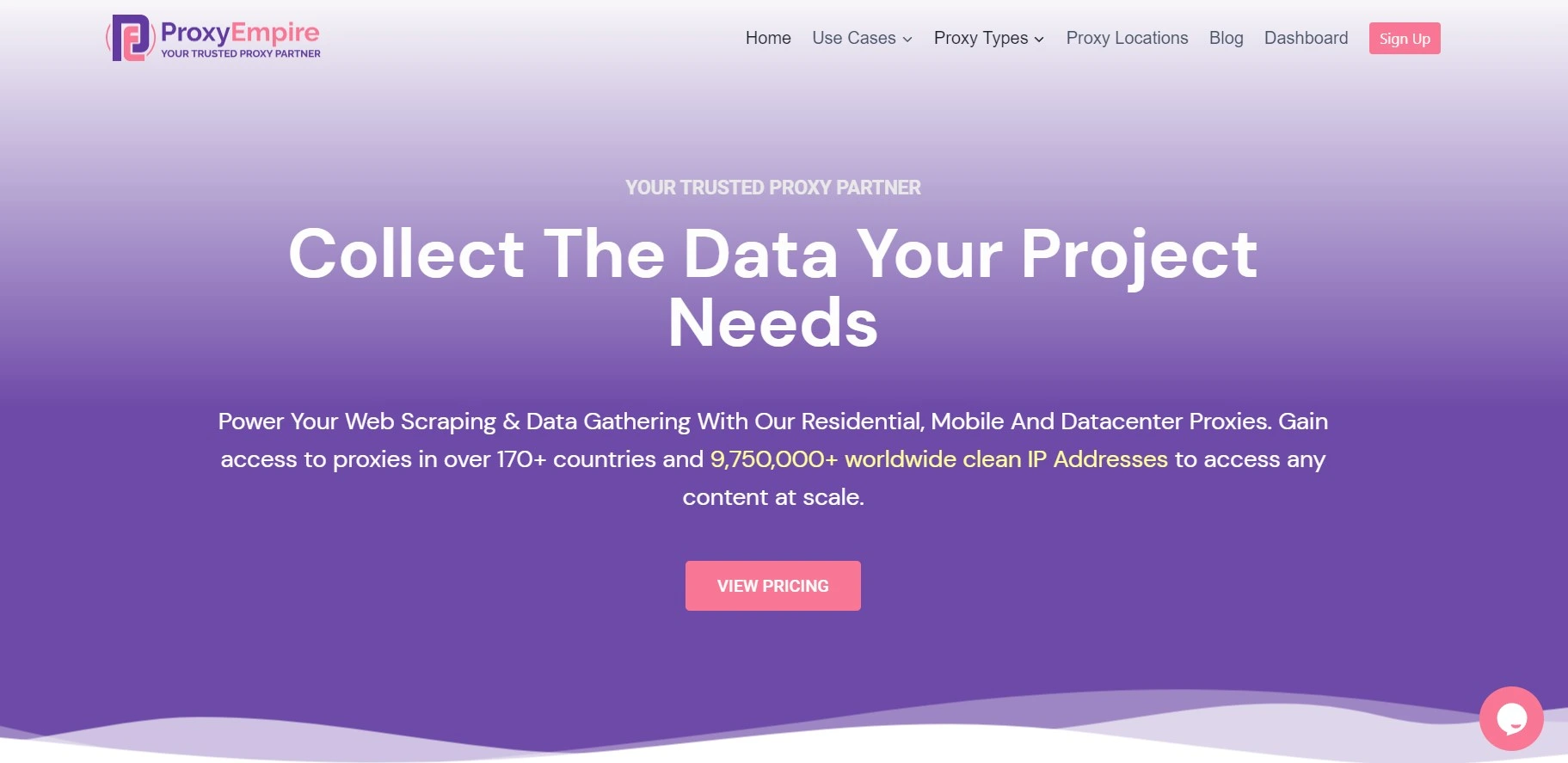
Our take: ProxyEmpire punches above its size on targeting — you can filter by country, region, city, and even mobile carrier across 170+ countries, at prices closer to the budget tier than the enterprise one. Rollover data (unused GB carries forward on paid plans) sweetens the deal.
The 9M+ pool is mid-sized, and the dashboard feels more functional than polished — but for geo-specific scraping and ad verification in less common countries, it’s often the most cost-effective way in.
Key Features:
- 9M+ rotating residential IPs in 170+ countries
- Deep geo-targeting: country, region, city, carrier
- Rollover bandwidth on plans
- Unlimited concurrent threads, 24/7 support
Pricing: from roughly $1.97/GB pay-as-you-go.
Best for: geo-specific campaigns without enterprise budgets. Not ideal for: those who want the biggest possible pool or the slickest dashboard.
5. Nimbleway — for AI-driven data pipelines
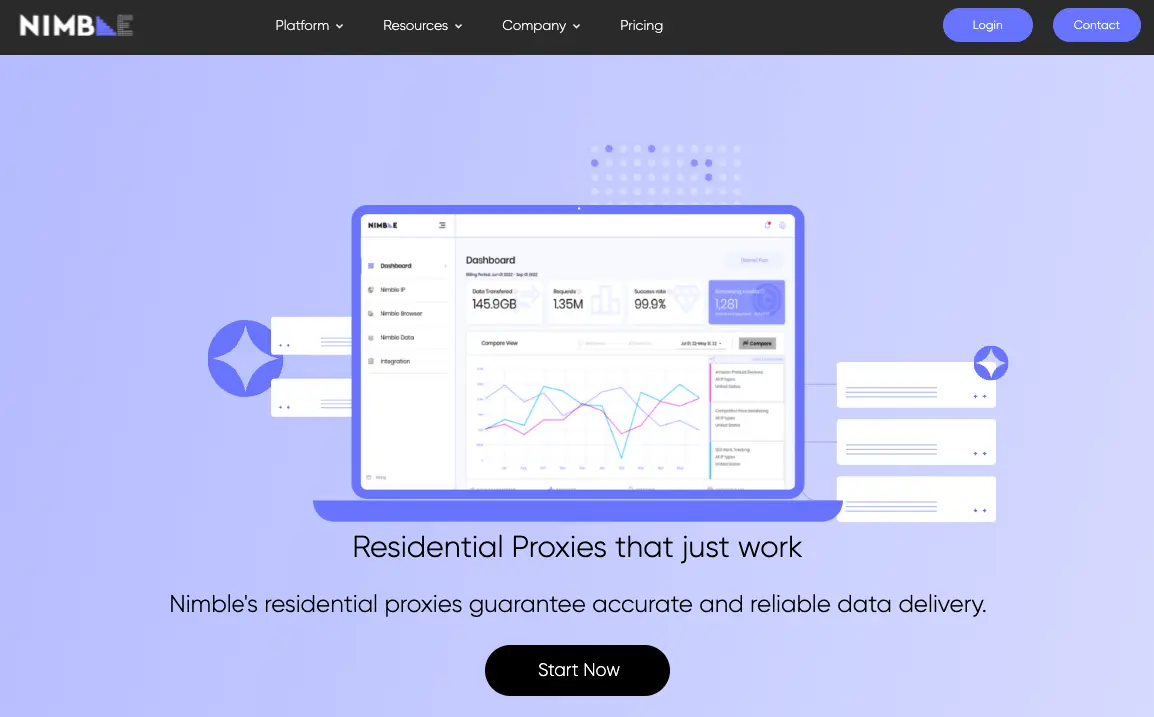
Our take: Nimbleway has evolved from a pure proxy seller into a data-collection platform — premium residential IPs plus AI-assisted unblocking and structured web APIs. IP quality is genuinely high and granular geo-targeting reaches any location, but you’re buying into a platform, not just raw GBs.
That makes it a strong fit for teams feeding data into AI or analytics pipelines, and overkill for someone who just needs a handful of clean IPs.
Key Features:
- Premium residential IP quality with smart unblocking
- Granular targeting down to any geolocation
- Full-featured dashboard + Admin API for account automation
- Structured data/Web API options beyond raw proxies
Pricing: usage-based plans — check the official pricing page for current rates.
Best for: data teams wanting proxies + unblocking + APIs in one platform. Not ideal for: casual users who just need cheap GBs.
6. Decodo (formerly Smartproxy) — best value for most users
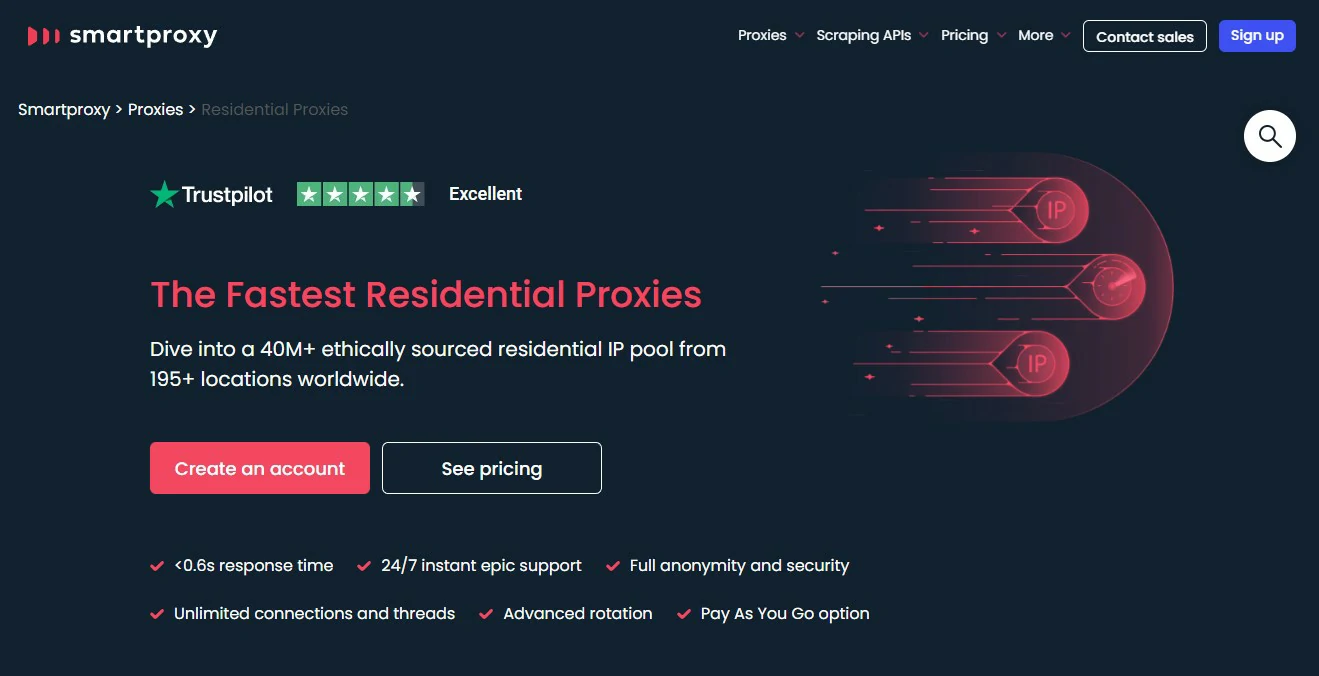
Our take: Smartproxy rebranded to Decodo in 2025, and the value proposition survived the name change: a huge 115M+ IP pool, genuinely easy setup, and pricing around ~$2/GB that undercuts the premium duo while staying close on success rate. This is our default recommendation for freelancers and small teams.
You get rotating and 30-minute sticky sessions, 195+ locations, unlimited connections, and no setup fees. We’ve covered the platform in depth in our Smartproxy (Decodo) review and compared it with the market leader in Bright Data vs Smartproxy.
Key Features:
- 115M+ residential IPs in 195+ locations
- Rotating & 30+ minute sticky sessions
- Unlimited connections, no setup fees
- X-Browser anti-detect tool + browser extensions
Pricing: from roughly $2/GB pay-as-you-go.
Best for: the best price-to-quality ratio in the list. Not ideal for: carrier/ASN-level targeting — that’s Bright Data territory.
7. NetNut — fastest via direct ISP connectivity
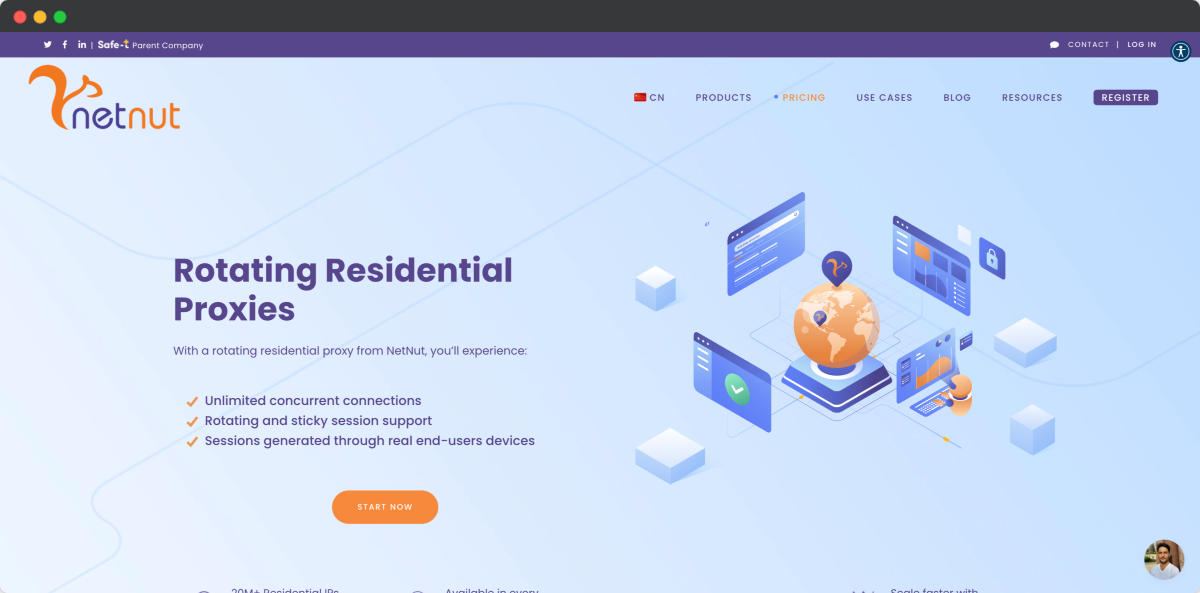
Our take: NetNut’s architecture is its edge — a hybrid network that connects directly to ISPs instead of relying purely on peer devices. The practical result: IPs stay available 24/7 (no device going offline mid-session) and speeds are consistently high, which matters for time-sensitive data gathering.
It’s pitched at businesses more than individuals — pricing is volume/plan-based rather than casual pay-as-you-go. See how it stacks up against the leader in Bright Data vs NetNut.
Key Features:
- Direct ISP connectivity — stable, always-on IPs
- 85M+ IPs: rotating residential + static ISP options
- Automatic per-session rotation for high success rates
- Granular geo-targeting + API access
Pricing: volume-based plans — check the official pricing page.
Best for: speed-critical, always-on business scraping. Not ideal for: small one-off projects — entry plans assume real volume.
8. StormProxies — simple unlimited-bandwidth ports
Our take: StormProxies keeps it old-school — you rent ports with unlimited bandwidth instead of paying per GB. If your workload chews through traffic (SEO tools, traffic bots, continuous monitoring), a flat monthly port can be dramatically cheaper than metered GBs. The trade-off is a smaller pool and simpler targeting than the premium networks.
Key Features:
- Unlimited bandwidth on port-based plans
- Automatic IP rotation, instant setup
- Specialized dedicated proxies (social platforms, sneakers)
- 24-hour money-back guarantee
Pricing: port-based monthly plans — check the official site for current rates.
Best for: heavy-bandwidth users on a fixed budget. Not ideal for: precise geo-targeting or hard anti-bot targets.
9. Shifter — cheap rotating proxies at volume
Our take: Shifter (the former Microleaves) runs one of the oldest peer-to-peer residential networks and competes hard on price — rotating residential traffic from around $0.75/GB, with both metered and port-style plans. HTTP(S) and SOCKS support plus unlimited sessions make it flexible for SEO, scraping, and brand-protection work.
Quality can vary more than the premium pools — budget P2P networks always do — so test with a small package first.
Key Features:
- Large P2P residential network, global coverage
- HTTP(S) + SOCKS protocol support
- Unlimited concurrent sessions
- Residential, static residential & datacenter options
Pricing: from roughly $0.75/GB; monthly plans from ~$44.
Best for: cost-driven volume scraping. Not ideal for: mission-critical jobs where every request must succeed.
Common mistakes when buying residential proxies
- Paying premium rates for easy targets. If the site barely has bot protection, cheaper datacenter or ISP proxies do the job for a fraction of the cost.
- Ignoring the billing model. Per-GB is great for light use; port-based/unlimited wins for heavy bandwidth. Estimate your monthly GB before choosing.
- Buying big before testing. Every serious provider offers a trial, small package, or money-back window — run your actual workload against your actual targets first.
- Choosing rotating when you need sticky (or vice versa). Scraping wants rotation; account management wants stable sessions. Mismatching causes bans — see rotating vs static proxies.
- Falling for free proxies. Free residential IPs are usually hijacked devices or honeypots that read your traffic. If you aren’t paying, your data is the payment.
How we evaluated these providers
We’ve used several of these networks (Oxylabs, Bright Data, Smartproxy/Decodo, IPRoyal) on our own scraping and SEO projects and have reviewed most of them individually on DroidCrunch over the years. For this update we re-verified that every provider is still operating, refreshed starting prices from official pricing pages (July 2026), and removed one provider — GeoSurf — that has shut down. What we weigh: pool size and IP quality, success rate on protected targets, targeting options, pricing model fit, and support. Disclosure: some links are affiliate links — if you buy through them we may earn a commission at no extra cost to you. That never changes the order or the verdicts; our opinions are earned, not sponsored.
FAQs
What is a residential proxy provider?
A residential proxy provider rents you access to real ISP-assigned home IP addresses, so your online activity looks like normal visitor traffic. They are used for web scraping, ad verification, SEO monitoring, and accessing geo-restricted content without detection.
How do residential proxies differ from datacenter proxies?
Residential proxies use real ISP-assigned home IPs, making them much harder to detect and block. Datacenter proxies come from cloud servers and are easily flagged by anti-bot systems. Residential wins on anonymity and success rate; datacenter wins on speed and price.
What are the best use cases for residential proxies?
Web scraping and price monitoring, social media and multi-account management, ad verification, SEO rank tracking, sneaker and ticket purchasing, and testing geo-restricted content. Any task where being detected as automation gets you blocked is a residential proxy use case.
How do rotating residential proxies work?
Rotating proxies automatically switch your IP at set intervals or on every request, spreading traffic across many real addresses. This dramatically reduces detection and bans during scraping and automation. For account management, sticky sessions that hold one IP for longer are usually the better choice.
What factors should you consider when choosing a residential proxy provider?
Check the IP pool size, success rate on your actual targets, geo-targeting depth, pricing model (per GB vs port-based), rotation and sticky-session options, ethical IP sourcing, and support quality. Always test with a small package before committing to a big plan.
Are residential proxies legal to use?
Yes, using residential proxies is legal in most countries when used ethically – for public data collection, ad verification, and testing. However, fraud, unauthorized access, or violating a website’s terms of service can still get you in trouble regardless of the proxy type. Stick to reputable providers with ethically sourced IPs.
Which are the best residential proxy providers in 2026?
Our top picks are Oxylabs (best overall), Bright Data (most advanced targeting), Decodo – formerly Smartproxy (best value), and IPRoyal (best budget option with non-expiring traffic). ProxyEmpire, NetNut, Nimbleway, StormProxies, and Shifter round out the list for specific needs.
Conclusion
Here’s the bottom line on residential proxy providers. If failed requests cost you money, pay for Oxylabs or Bright Data — their pools and success rates are why they lead the market. If you want 90% of that quality at half the price, Decodo is the sweet spot. On a tight budget or with occasional needs, IPRoyal’s non-expiring traffic means you never pay for GBs you don’t use. And if you burn heavy bandwidth, do the math on StormProxies or Shifter before paying per GB.
One warning before you spend money: never judge a proxy network by its homepage claims. Buy the smallest package, point it at your real targets for a week, and watch the success rate — that’s how we test, and it has saved us from plenty of expensive mistakes. If you hit connection issues along the way, our guide to common proxy errors and fixes will save you some support tickets.