

Scraping Google yourself is a losing game. You’ll burn more hours rotating proxies and beating CAPTCHAs than you’ll ever spend reading the data. That’s the whole point of SERP APIs: send a keyword, get clean JSON back.
The trap is pricing. A plan that looks cheap at 1,000 searches turns brutal at a million, and the gap between the cheapest and dearest vendor here is more than tenfold for the same Google search results data.
We’ve run these on live client projects. Here’s which SERP scraping API earns its budget, and which one quietly drains it. If you want the DIY route first, read our guide on how to scrape Google search results safely.
Best SERP APIs in 2026, at a glance
Quick verdict
- Best value at scale Oxylabs Web Scraper API
- Easiest to ship with SerpApi
- Cheapest real starting point Decodo, from $19/mo
- Biggest infrastructure Bright Data
- Every tool here returns parsed JSON, not raw HTML you have to regex
- All of them handle proxy rotation and CAPTCHAs for you
- Free tiers or trials exist on all four of our top picks
- Per-request pricing varies by more than 10x between vendors
- Cheap credit plans get expensive once JavaScript rendering is switched on
If you are tracking rankings at volume, Oxylabs gives you the lowest honest cost per thousand Google results. If you want to be shipping code in ten minutes and volume is modest, pay the premium for SerpApi.
| Feature | ||||
|---|---|---|---|---|
| Free tier or trial | Yes | Yes | Yes | Yes |
| What the free tier gives you | 2,000 results, no card | 5,000 requests a month | 250 searches a month | 5,000 credits, 7 days |
| Entry plan | $49/mo | $499/mo | $25/mo(winner for this row) | $49/mo |
| Google cost per 1,000 results | $1.00 (Micro), $0.60 at Business(winner for this row) | $1.50 pay as you go | $10 at Production tier | Credit based, varies |
| Pay as you go, no subscription | No | Yes(winner for this row) | No | No |
| Parsed JSON out of the box | Yes | Yes | Yes | Yes |
| Non-Google targets on the same key | Yes | Yes | Yes | Yes |
| Setup friction |
We may earn a commission when you buy through links on this page. This does not affect our reviews.
How we evaluated these
We’ve used Bright Data, Oxylabs, ScraperAPI, SerpApi and Decodo on real client work, mostly rank tracking and competitor monitoring for SEO projects. What we judged: how quickly a first successful call happens, how clean the parsed output is, whether localisation actually works, and what the invoice says at the end of the month.
What we didn’t do: benchmark every vendor at a million requests a day, or test serpstack, Crawlbase, Apify, Zenserp and SERPMaster on production workloads. Those entries are based on official docs, pricing pages and trial accounts, and we’ve said so in each section. All prices below were checked in July 2026 against the vendors’ own pricing pages, and SaaS pricing moves, so verify before you buy. Some links here are affiliate links, which is how we keep the lights on. It doesn’t change the ranking.
What a SERP API actually does for you
You send a keyword, a location and a device type. The vendor runs that query through its own proxy pool, handles the block page when Google throws one, parses the HTML, and hands you a structured object. Organic results, ads, People Also Ask, local packs, shopping listings, AI Overviews. No parser of yours to maintain.
That last part is the real product. Google reshuffles its markup constantly, and a hand-rolled scraper breaks on a Tuesday for no reason you can explain to a client. You’re paying someone else to own that maintenance. If you’d rather own it yourself, you’ll need a serious proxy layer first, which we cover in the role of proxies in web scraping.
Where teams actually use this: rank tracking dashboards, competitor ad monitoring, keyword gap analysis, brand mention alerts, and feeding fresh SERP snapshots into content briefs. The pattern is always the same. Bulk queries on a schedule, stored over time, so trends show up.
Expert take: Cost per successful request is the only number that matters. Headline plan prices hide credit multipliers, JavaScript rendering surcharges and failed-request billing. Work out your real per-thousand rate before you sign anything annual.
The best SERP APIs we would actually pay for
Oxylabs Web Scraper API – best value for rank tracking at volume
This is the one we point most SEO teams at. Oxylabs folds its old SERP API into a single Web Scraper API, and the pricing is the clearest signal of intent in the category: $1.00 per 1,000 Google results on the entry plan, dropping to $0.60 once you are at Business volume. Nobody else at this quality level is close.
It handles JavaScript rendering, per-city geotargeting and headless browsing, and it parses the awkward stuff correctly, including AI Overviews and local packs. The docs assume you can write code, which is fine, but a marketer without a developer will struggle on day one.
- Parsed JSON for organic, ads, local, shopping and AI Overviews
- City-level geotargeting, not just country level
- JavaScript rendering priced separately so you only pay when you need it
- Free trial of 2,000 results with no card
- Same key works for Amazon and other non-Google targets
Pricing: Micro $49/mo (up to 98,000 results), Starter $99/mo (220,000), Business $999/mo (3.33M), Custom+ from $0.25 per 1,000. Free trial: 2,000 results.
Best for: Agencies and SaaS products running scheduled rank tracking where cost per thousand actually shows up on a P&L.
Not ideal for: Non-technical users, or anyone who needs a dashboard rather than an endpoint.
Bright Data SERP API – best for scale and awkward requirements
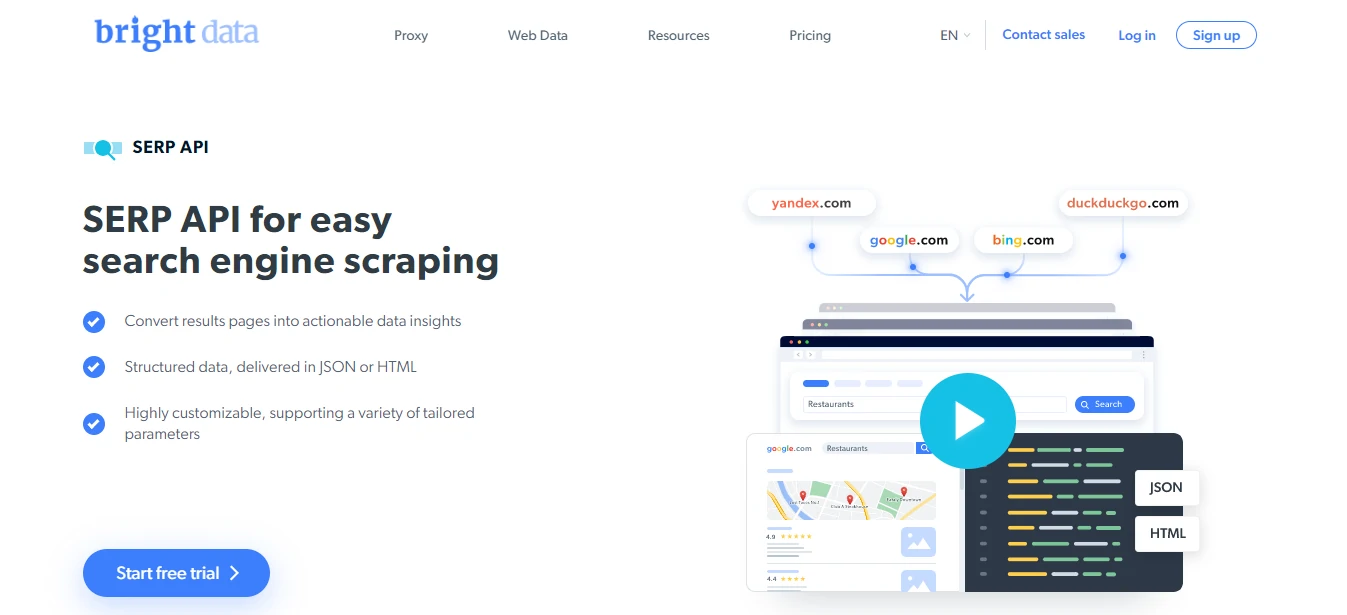
Bright Data is the biggest infrastructure player in this list, and it shows in coverage: obscure countries, unusual SERP features, and the sort of compliance paperwork enterprise buyers ask for. It was Luminati before the rebrand, and it has been doing this longer than most of the field.
The pay-as-you-go rate is the genuinely useful part. $1.50 per 1,000 requests with no subscription means you can run a project for three weeks and stop. The Scale plan at $499 a month for 380,000 requests only makes sense if you are consistently past that volume. We compared it head to head with its closest rival in Bright Data vs Smartproxy.
- Pay as you go with no monthly commitment
- Free tier of 5,000 requests a month
- Broadest country and SERP-feature coverage we have tested
- Only successful deliveries are billed
- Enterprise compliance and account management if you need it
Pricing: $1.50 per 1,000 requests pay as you go; Scale $499/mo for 380,000 requests then $1.30 per 1,000; free tier 5,000 requests a month.
Best for: Large-scale collection, unusual geographies, and teams that need a contract rather than a credit card.
Not ideal for: Small projects. The dashboard is dense and the onboarding assumes you have a use case worth a sales call.
SerpApi – easiest to ship with, and you pay for it
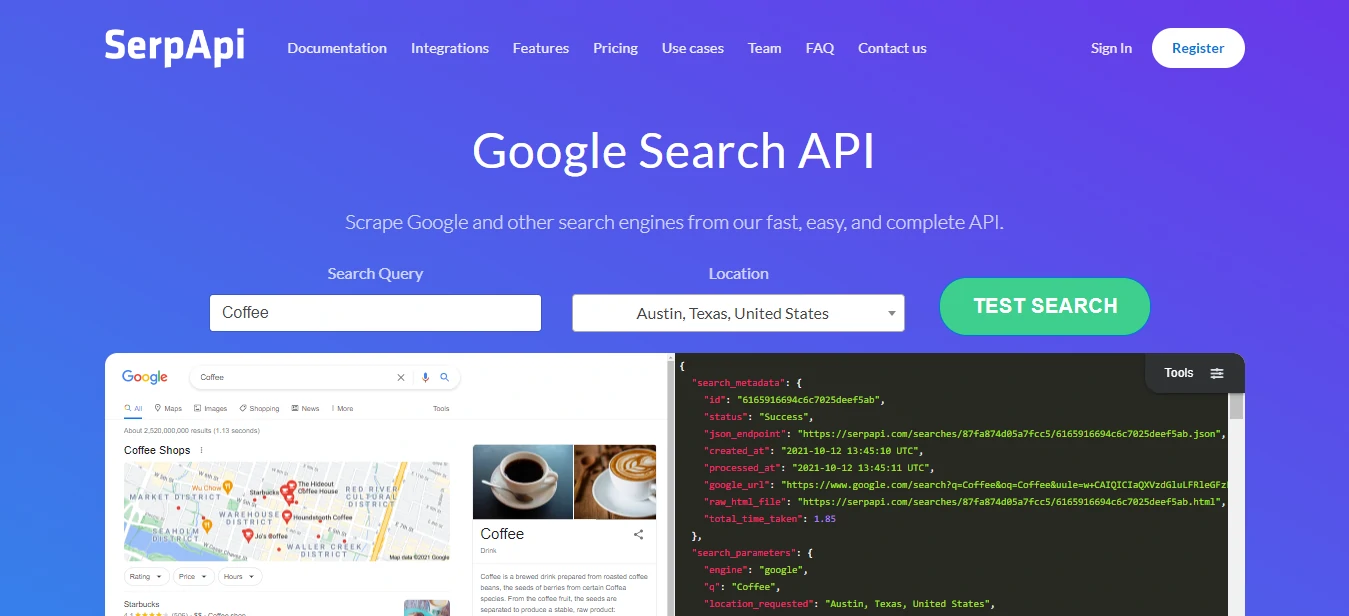
SerpApi is the one you choose when the deadline is Friday. The docs are the best in the category, the playground lets you build a query in the browser and copy working code out, and the response schema is stable enough that you can write against it without defensive coding.
It is also the most expensive per search by a wide margin. At the Production tier you are paying roughly $10 per 1,000 searches, about ten times the Oxylabs rate. What you buy for that is speed of implementation and a legal shield bundled into paid plans, which some companies genuinely need. IBM and Harvard are on the customer list.
- Best documentation and in-browser playground of any vendor here
- Free tier of 250 searches a month, no card
- Legal shield included on paid plans
- Stable, well-named response schema across engines
- Roughly 2 to 5 second average response time
Best for: Developers and small teams under 15,000 searches a month who value shipping speed over unit cost.
Not ideal for: Anyone running six-figure query volumes. The maths stops working around the Big Data tier.
SerpApi plans
The clearest pricing in the category: you buy searches, not credits.
- Included: 250 searches a month
- Included: All search engines
- Not included: Commercial use
- Included: 1,000 searches a month
- Included: Legal shield included
- Not included: Priority support
- Included: 15,000 searches a month
- Included: Higher hourly throughput
- Included: Legal shield included
- Included: 30,000 searches a month
- Included: Higher hourly throughput
- Included: Legal shield included
Prices checked July 2026 on the official SerpApi pricing page. Overages and higher throughput are billed separately.
We may earn a commission when you buy through links on this page. This does not affect our reviews.
ScraperAPI – best if Google is only part of the job
ScraperAPI is a general web scraping API with structured endpoints for Google bolted on, and that framing matters. If your pipeline pulls SERPs plus product pages plus a dozen competitor sites, one key covering all of it beats juggling three vendors. We wrote a full Scraper API review after using it on a live project.
Here is the catch, and it is the reason ScraperAPI sits fourth rather than first. Pricing is credit based, and a Google search with rendering and geotargeting eats far more credits than a plain fetch. Read the multiplier table before you budget, because the headline 100,000 credits is not 100,000 searches.
- One API key for Google, Amazon, Walmart and arbitrary URLs
- Automatic proxy rotation, CAPTCHA handling and retries
- Structured Google Search, News and Shopping endpoints
- 7-day trial with 5,000 credits
- Async endpoint for large batch jobs
Pricing: Hobby $49/mo for 100,000 API credits, then Startup, Scaling, Professional and Advanced tiers up to roughly $1,975/mo. Credits per request vary by target and options.
Best for: Data teams whose scraping is broader than search results.
Not ideal for: Pure rank tracking, where the credit maths makes it dearer than it looks.
Decodo, formerly Smartproxy – the cheapest sensible starting point
Smartproxy renamed itself Decodo in April 2025. Same Lithuanian team, same IP pool, new logo. If you have an old Smartproxy bookmark, that is why it redirects.
The reason it is here is the entry price. $19 a month buys 38,000 standard requests on the Web Scraping API, and there is a genuinely usable free plan on top. For a solo SEO or a small agency testing whether automated rank tracking is worth building at all, that is the least risky first cheque in this list. The proxy network underneath is solid too, which we covered in our roundup of the best residential proxy providers.
- Free plan with 2,000 standard requests, no card
- Starter at $19/mo for 38,000 requests
- Full-stack setup: scraper, parser and proxy network in one
- AI-assisted parser for sites without a ready-made template
- 14-day money-back guarantee
Pricing: Free, Starter $19/mo (38K requests), Professional $49/mo (163K), Business $99/mo (707K). Rates run roughly $0.14 to $1.50 per 1,000 depending on proxy type and tier.
Best for: Solo SEOs, small agencies and anyone validating an idea before committing budget.
Not ideal for: Teams that need dedicated SERP feature parsing at enterprise scale. That is Oxylabs and Bright Data territory.
serpstack – a free forever tier and simple per-search pricing

Built by APILayer, the team behind Currencylayer and a stack of other small APIs, serpstack does one thing: it returns Google results as JSON, quickly, without a learning curve. There are no credits to reason about. You buy searches.
The free tier is 100 searches a month and it does not expire, which makes it a decent way to prototype. Paid plans start at $29.99 for 5,000 searches, which is fine at small volume and uncompetitive above roughly 20,000. Feature coverage is narrower than the top four, so check that the SERP block you care about is actually parsed. We have not run this one on a live project.
- Free forever plan with 100 searches a month
- No credit system, just a search count
- Covers organic, images, video, news, shopping and ads
- Location and device parameters supported
Pricing: Free (100 searches), Basic $29.99/mo (5,000), Business $99.99/mo (20,000), Business Pro $199.99/mo (50,000). Annual billing knocks off roughly 10 to 15 percent.
Best for: Prototypes and low-volume tools where simple beats cheap.
Not ideal for: Scale. Cost per search never improves enough to compete.
Crawlbase, formerly ProxyCrawl – generous free allowance
ProxyCrawl became Crawlbase a few years back. It is a general crawling platform with a dedicated Google SERP scraper, cloud storage for results, and screenshot capture, which is a nice touch when you need visual evidence of a SERP rather than just the data.
The headline feature is the free allowance: up to 20,000 requests with no card. Pricing after that is complexity-based per request rather than a flat per-thousand rate, which is honest but makes forecasting harder than it should be. Research-only entry for us; we have not run it in production.
- Up to 20,000 free requests to start
- Dedicated Google SERP scraper alongside general crawling
- Full-page screenshots in JPEG
- Cloud storage for scraped results
- Only successful requests are charged
Pricing: Usage-based per request on the Crawling API, with complexity affecting the rate. Smart AI Proxy subscriptions run Starter $149/mo, Advanced $229/mo, Premium $449/mo. Cloud storage from $29/mo.
Best for: Mixed crawling projects that need storage and screenshots as well as SERP data.
Not ideal for: Anyone who wants a predictable monthly number on the invoice.
Apify – a marketplace of scrapers rather than a SERP API
Apify is a platform for running scrapers built by other people, called Actors, plus your own. The Google Search Results Scraper pulls organic listings, ads, People Also Ask and related queries, and you can schedule it without writing a line of code.
That is the appeal and the limitation. If you want a scheduled export into Google Sheets, Apify gets you there faster than any pure API. If you want a low-latency endpoint inside your own product, the Actor model adds a layer you did not ask for. Compute-unit pricing also needs watching. We use Apify for one-off extractions, not production rank tracking.
- Ready-made Actors for Google, Instagram, Maps and hundreds more
- Built-in scheduling, storage and dataset exports
- Residential and datacenter proxies included
- No-code path for non-developers
Pricing: Free tier with monthly platform credit, then paid plans on top. Individual Actors charge per result or per compute unit, so check the Actor page for your real cost.
Best for: Marketers who want scheduled SERP exports without engineering time.
Not ideal for: Latency-sensitive, high-frequency querying inside an application.
Zenserp – straightforward, but priced above its weight
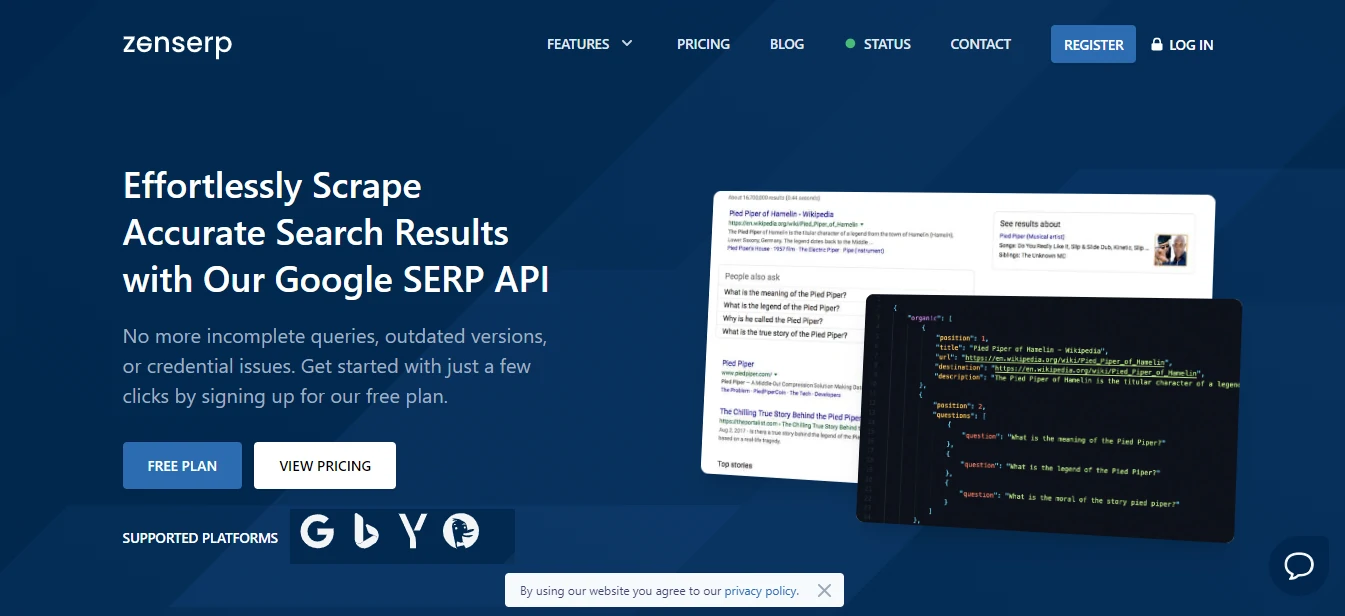
Zenserp does the basics competently. Real-time JSON, geolocated results, code samples for cURL, Python, Node and PHP, and a free tier so you can test the response shape before paying.
Our honest read: $49.99 for 25,000 searches is roughly $2 per thousand, which is double what Oxylabs charges for a broader feature set. There is nothing wrong with Zenserp. There is just no reason to pick it over the top four unless you already have an account. Research-only entry.
- Free plan with 50 searches
- Geolocated results down to city level
- Clean JSON with consistent field naming
- Batch endpoints from the Medium tier upward
Pricing: Free (50 searches), Small $49.99/mo (25,000), Medium $149.99/mo (100,000), Large $299.99/mo (250,000), up to Enterprise $899.99/mo (1M). Annual billing saves 20 percent.
Best for: Existing customers and teams who want batch endpoints without much setup.
Not ideal for: Cost-sensitive buyers. Better rates exist for the same job.
SERPMaster – small vendor, low prices, do your due diligence
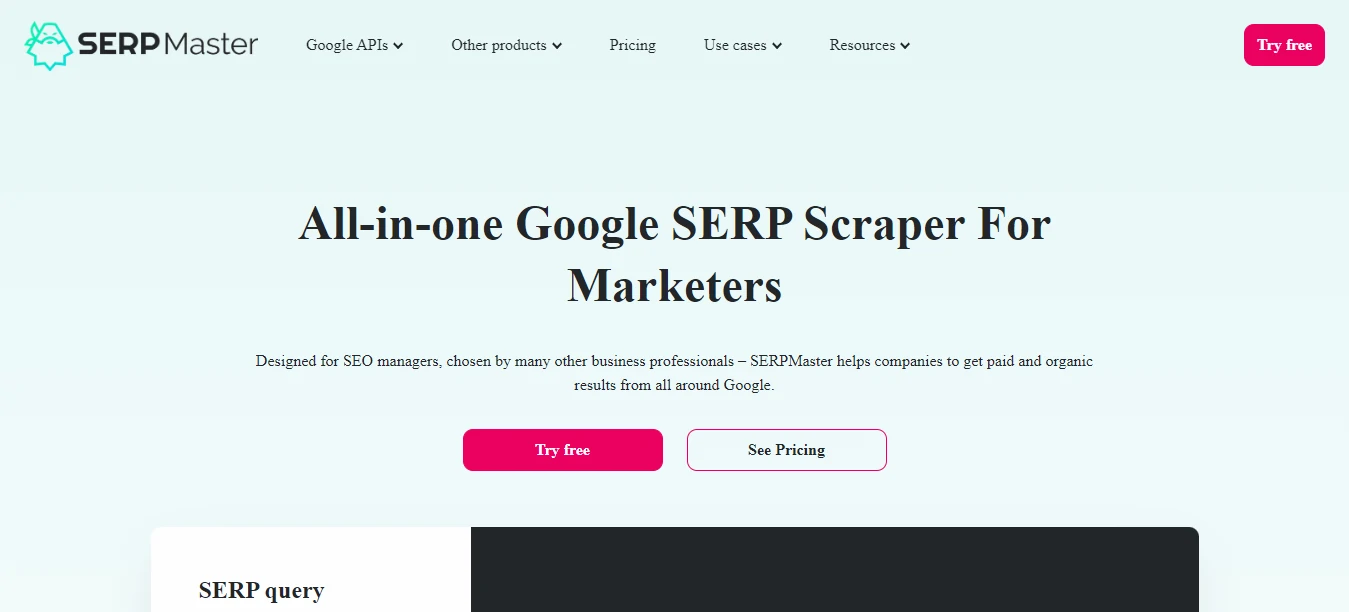
A note before anything else: this article previously linked to serpmasters.com, which is not the right domain. The live product sits at serpmaster.com. Apologies if you clicked the old one and hit nothing useful.
SERPMaster is a small operation, founded in 2020 and still in single-digit headcount, competing purely on price with entry pricing around $20 a month. It covers Google Search, Images, News, Scholar and Shopping, and the integration samples cover cURL, Python, PHP and Node. If it fits your budget, test it properly. Just size the vendor risk honestly before you build a client-facing product on top of a team that small. We have not tested it on a live project.
- Aggressive entry pricing, from roughly $20/mo
- Google Search, Images, News, Scholar and Shopping endpoints
- HTML or structured JSON output
- Code samples for cURL, Python, PHP and Node.js
Best for: Hobby projects and cost-first buyers who are comfortable with a small vendor.
Not ideal for: Anything where a vendor disappearing would break a client deliverable.
Four mistakes that make a SERP API expensive
- Buying credits without reading the multiplier table. On credit-based vendors, a plain fetch might cost one credit while a Google search with JavaScript rendering and geotargeting costs twenty-five. Your 100,000-credit plan is suddenly 4,000 searches.
- Requesting more results than you read. Pulling 100 results per query when your dashboard shows the top 10 multiplies your bill for data nobody looks at.
- Ignoring the location parameter. Untargeted queries return a mush of regional results, and you’ll re-run the whole batch once someone notices. Set country, language and device on every call.
- Committing annually before a volume test. Run a fortnight on pay as you go, measure your real success rate and per-thousand cost, then buy the plan. Every vendor here has a free tier for exactly this.
One more thing worth saying plainly: a SERP API is raw material, not analysis. You still need something to turn 50,000 rows into a decision, which usually means pairing it with proper keyword research tools rather than replacing them.
Frequently Asked Questions
Is scraping Google search results legal?
Scraping publicly visible search results is generally treated as legal in the US, and the hiQ Labs v. LinkedIn case is the usual reference point. It still breaches Google terms of service, which is a contract matter rather than a criminal one. SerpApi is the only vendor here that bundles a legal shield into its plans, which is part of what you pay the premium for. If you are in the EU, check GDPR exposure before you store anything that looks like personal data.
How much does a SERP API cost for 100,000 keywords a month?
At July 2026 list prices: roughly $100 on Oxylabs Starter, $150 on Bright Data pay as you go, and about $1,000 on SerpApi Production tier pricing. The spread is real, and it is the single biggest reason to size your volume before you pick a vendor rather than after.
Can I just use residential proxies instead of a SERP API?
You can, and it is cheaper per request. You then own the CAPTCHA solving, the header fingerprinting, the retry logic and the HTML parser that breaks every time Google shifts a div. We have run both. Raw proxies make sense when you already have scraping engineers; a SERP API makes sense when you would rather they worked on your product.
Do SERP APIs return AI Overviews and the newer Google blocks?
Coverage varies and it is the fastest-moving part of this category. Bright Data, Oxylabs and SerpApi all parse AI Overviews, People Also Ask, local packs and shopping results, though field names differ between them. Smaller vendors lag by weeks. Always run a live test query for the specific block you need before you commit to an annual plan.
Which SERP API is cheapest for a small project?
Decodo Starter at $19 a month is the lowest real entry point, and serpstack has a free forever tier at 100 searches a month. For anything you plan to run daily, SerpApi Starter at $25 for 1,000 searches is the least painful place to begin because you never have to reason about credit multipliers.
Why do my API rankings differ from what I see in my own browser?
Because your browser results are personalised by location, search history and account. API results are not. Set the location, language and device parameters explicitly on every call, and compare API data against API data over time rather than against your own screen. Ranking drift between the two is normal, not a bug.
Will Google block a rank tracker built on a SERP API?
Google blocks the scraper, not you. The vendor absorbs those blocks behind its proxy pool, which is exactly the service you are buying. What you should watch is the success rate on your invoice: most vendors only bill successful deliveries, so a sudden cost spike usually means retries, not extra data.
The bottom line
Pick on volume, not on marketing. Under 15,000 searches a month, take SerpApi and get on with building; the per-search premium is cheaper than two days of your time. Above that, Oxylabs is the best-value SERP API here, and the gap widens as you scale.
Bright Data is the one to call when you need odd SERP features, unusual countries or contractual guarantees, and its pay-as-you-go rate means you can start without a subscription. ScraperAPI earns its place if Google is only one of a dozen sites you scrape.
One warning before you spend. Never buy an annual plan off a headline price. Run two weeks on a free tier, log your real success rate and cost per thousand Google search results, then commit. That single habit has saved us more money than any discount code.