

“Pay once, use forever.” It’s a genuinely tempting pitch — no more monthly bills, no more subscription creep quietly draining your card. So you grab the lifetime deal, feel like a genius… and eighteen months later the tool is abandoned, buggy, or flat-out gone. Sound familiar?
We’ve been on both sides of this. Over the years we’ve bought dozens of lifetime deals on AppSumo and elsewhere — some are still workhorses in our stack today, a few vanished without a trace, and plenty got refunded inside the window. So we’re not here to hype them or trash them.
Here’s the honest answer to “are lifetime SaaS deals worth it?”: sometimes — and this guide shows you exactly how to tell the winners from the money pits before you spend a rupee or a dollar. We’ll cover the real risks, the break-even math, a buy-or-skip checklist, and which tools actually pay off. Let’s get into it.
ℹ️ Disclosure: Some lifetime-deal links here are affiliate links — and yes, we buy a lot of these ourselves. It never changes our verdict; we’ll happily tell you when a deal is a dud.
📌 Key Takeaways
- “Lifetime” means the life of the product, not yours. If the tool dies, so does your access.
- A lifetime deal is worth it when you’ll use the tool for years and the company is stable enough to survive.
- The math only pays off if the tool outlives the break-even point (often 6–12 months vs the annual plan).
- Buy through a marketplace with a generous refund window (AppSumo gives 60 days) — it turns risk into a free trial.
- Best LTDs: simple, low-cost tools you’ll actually use. Worst: shaky startups and services with heavy running costs.
⚡ The Short Answer
Yes — for the right tool. A lifetime deal on a tool that solves a real, ongoing need from a company with a healthy roadmap is one of the best deals in software. No — for the wrong one. A cheap code for a tool you might use, from a one-person startup with no traction, is how deal graveyards get filled. The trick is telling them apart, and that’s exactly what the checklist below does.
What Is a Lifetime SaaS Deal (LTD)?
A lifetime SaaS deal (LTD) is a one-time payment that gives you long-term access to a piece of software instead of paying a recurring monthly or annual subscription. You pay once — often a fraction of a year’s subscription — and keep using the tool for as long as it exists.
A few things to understand about how they work:
- “Lifetime” = life of the product. It lasts as long as the company keeps that SaaS running — not literally forever.
- Tiers and “codes.” Deals come in tiers; stacking multiple codes unlocks higher limits (more users, contacts, projects).
- Where they live. Most are sold through curated marketplaces — AppSumo is the biggest — plus direct vendor offers around launches and Black Friday.
Why Do Companies Even Offer Lifetime Deals?
This is the question that tells you everything about the risk. Selling lifetime access for a one-time fee sounds like terrible business — and for a mature company, it usually is. So who does it, and why?
- Fast cash. Early-stage startups sell LTDs to raise money quickly without giving up equity.
- Users and feedback. A flood of early users stress-tests the product and generates reviews.
- Momentum. A big launch creates buzz, backlinks, and social proof.
Here’s the catch: the same reasons that make a company offer an LTD — it’s young and needs cash — are exactly the reasons it might not be around in three years. That’s the whole risk in one sentence.
The Upside: When Lifetime Deals Are Absolutely Worth It
- Massive long-term savings. A $69 one-time deal replacing a $15/month tool pays for itself in under five months — everything after is free.
- No subscription fatigue. One less recurring charge quietly eating your budget every month.
- Early access to great tools. Some of today’s excellent SaaS products launched as LTDs — early buyers locked in incredible value.
- Low-risk experimentation. With a refund window, you can genuinely test a tool for weeks, not minutes.
- Great for solopreneurs & small teams who’d rather own tools than rent a growing pile of them.
The Catch: The Real Risks of Lifetime Deals
- The product dies. The number one risk. If the company folds or sunsets the tool, your “lifetime” ends and your data needs a new home.
- Stalled development. Once the LTD cash is spent, some tools stop improving — you’re stuck on a frozen version while rivals race ahead.
- Feature and usage caps. Your tier may lock you out of the features that actually matter, nudging you to buy more codes or a paid upgrade.
- Weak support. Lifetime buyers sometimes get deprioritized behind paying subscribers.
- Shiny-object spending. The biggest hidden cost is buying deals you never use — a graveyard of $49 tools that felt clever at checkout.
The Honest Math: Do Lifetime Deals Actually Save Money?
The only number that matters is your break-even point — how long you’d have to keep the tool for the one-time price to beat the subscription. Cross that line and still be using it? You won. Tool dies before then? You lost. Here’s the shape of it:
| Scenario | Annual plan | Lifetime deal | Break-even |
|---|---|---|---|
| Small utility | ~$60/yr | ~$49 once | Under 1 year |
| Mid-range SaaS | ~$180/yr | ~$99 once | ~7 months |
| Premium tool | ~$500/yr | ~$299 once | ~7 months |
⚠️ The trap: a lifetime deal is only cheap if you’d have paid for the subscription anyway. Buying a $49 tool you use twice isn’t a saving — it’s a $49 expense. Never let the discount talk you into a tool you don’t actually need.
How to Evaluate a Lifetime Deal Before You Buy
This is the part that separates smart buyers from serial refunders. Before you hit “buy,” run every deal through this checklist — green flags mean go, red flags mean think twice.
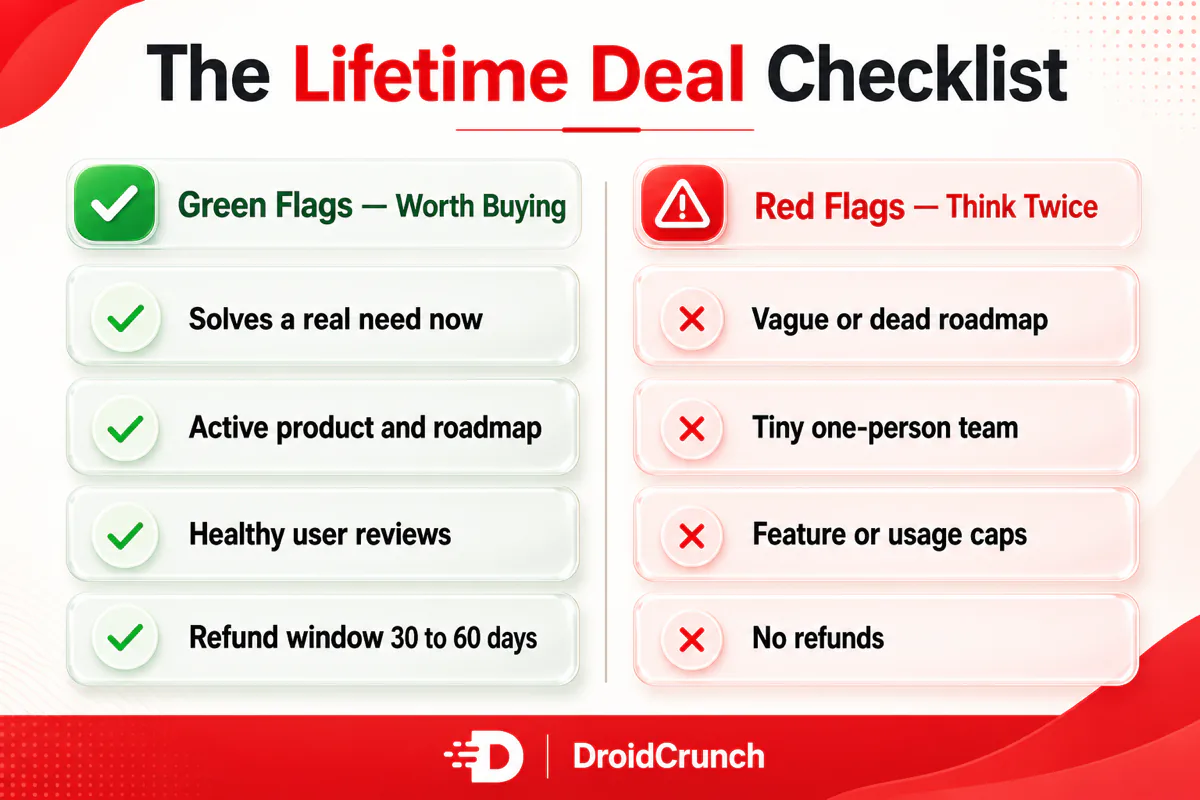
✅ Green flags (worth buying): it solves a problem you have right now; the company is active with a public roadmap and recent updates; reviews are genuinely positive (not just launch hype); there’s a real refund window; and the tier limits fit your actual usage.
🚩 Red flags (think twice): a vague or dead roadmap; a tiny one-person team with no track record; harsh feature or usage caps designed to upsell; heavy running costs (email sending, AI credits) the vendor may later throttle; no refund policy; and “I might use it someday” as your only reason.
Best (and Worst) Tools to Buy as Lifetime Deals
Best bets are simple, self-contained tools with low running costs — the vendor can keep them alive cheaply, so your deal is safer:
- WordPress plugins and themes
- Design, image, and content utilities
- Productivity and note-taking tools
- Link shorteners, form builders, and other “set and forget” utilities
Riskier bets are services with heavy ongoing costs, where “lifetime” is hard to sustain and limits tend to tighten over time:
- Email marketing tools (sending has real per-message cost)
- AI tools that burn credits or GPU time on every use
- Anything hosting large files or heavy storage
- Mission-critical tools you can’t afford to lose if the company folds
Browsing options? Start with our deals coverage and software reviews — and for AI-specific picks, the AI tools hub. We test tools like n8n and Beehiiv on live projects, so you know what you’re actually buying.
Where to Buy — and the Refund Window That Protects You
Where you buy matters almost as much as what you buy, because a strong refund policy turns a risky purchase into a genuine free trial.
- AppSumo — the largest marketplace, with a 60-day, no-questions-asked refund window. That’s two months to actually put a tool to work before committing.
- Other marketplaces — platforms like Dealify and PitchGround also curate lifetime deals; check each one’s refund terms.
- Direct from vendors — often around launches or Black Friday; refund terms vary, so read them carefully.
✅ Real-world tip: treat the refund window as the trial the deal doesn’t advertise. Buy it, set a reminder for a few days before the window closes, and actually use it. If it hasn’t earned a place in your workflow by then, refund it — no guilt.
Common Mistakes Buyers Make
- Buying for “someday.” If you don’t have a use for it this month, you probably never will.
- Ignoring the tier limits. The cheap tier often can’t do the one thing you bought it for. Read the fine print.
- Skipping the reviews. Launch-day reviews are hype; look for what people say weeks later.
- Forgetting the refund window. The single most expensive mistake — letting a dud’s refund window quietly expire.
- Going all-in on critical tools. Don’t bet your business on a young LTD startup for something you can’t afford to lose.
Frequently Asked Questions
Are lifetime SaaS deals worth it?
Lifetime SaaS deals are worth it when the tool solves a real need you will use for years and the company is stable enough to survive. They are a bad bet on shaky startups or tools you might not stick with. Judge each deal individually, not the model.
What does lifetime mean in a lifetime deal?
Lifetime usually means the lifetime of the product, not your own. You pay once and keep access for as long as the company keeps that product running. If the tool is shut down or the company folds, your access can end.
Where can I buy lifetime SaaS deals?
The biggest marketplace is AppSumo, which curates software lifetime deals with a 60-day refund window. Others include Dealify and PitchGround, plus direct offers from vendors on their own sites, especially around launches and Black Friday.
Are lifetime deals a scam?
Lifetime deals are not a scam. They are a legitimate way for startups to raise cash and gain users. The risk is not fraud but longevity: some tools underdeliver or shut down. A generous refund window and honest reviews are your protection.
How do I know if a lifetime deal is a good one?
Check that the tool solves a problem you have right now, the company is active with a public roadmap, reviews are genuinely positive, and there is a refund window. Avoid deals with vague roadmaps, tiny teams, harsh usage caps, or no refunds.
Do lifetime deals include all future updates?
Sometimes, but not always. Many deals include updates within the tier you bought, while major new features or higher usage may require extra codes or a paid upgrade. Always read exactly what your tier includes before you buy.
What types of tools are best as lifetime deals?
Simple, self-contained tools with low running costs make the best lifetime deals, such as utilities, plugins, and content tools. Avoid lifetime deals on services with heavy ongoing costs like email sending or AI credits, since the vendor may cap or change them later.
Can I get a refund on a lifetime deal?
Usually yes, within the marketplace refund window. AppSumo offers 60 days, no questions asked, which is enough time to actually test the tool. Always buy through a platform with a clear refund policy so a dud deal costs you nothing.
The Bottom Line
So, are lifetime SaaS deals worth it? The model isn’t good or bad — individual deals are. A lifetime deal on a genuinely useful tool from a company that’s clearly here to stay is one of the smartest software purchases you can make. A cheap code for a tool you “might” use, from a startup with no traction, is money you’ll wish you’d kept.
Buy when the tool solves a real need today, the company looks healthy, and there’s a refund window to fall back on. Skip when you’re buying on hype, the roadmap is thin, or the tool is mission-critical and the vendor is unproven. And whatever you buy, use that refund window like the free trial it really is — that one habit has saved us from far more bad deals than any amount of hype ever cost us.